
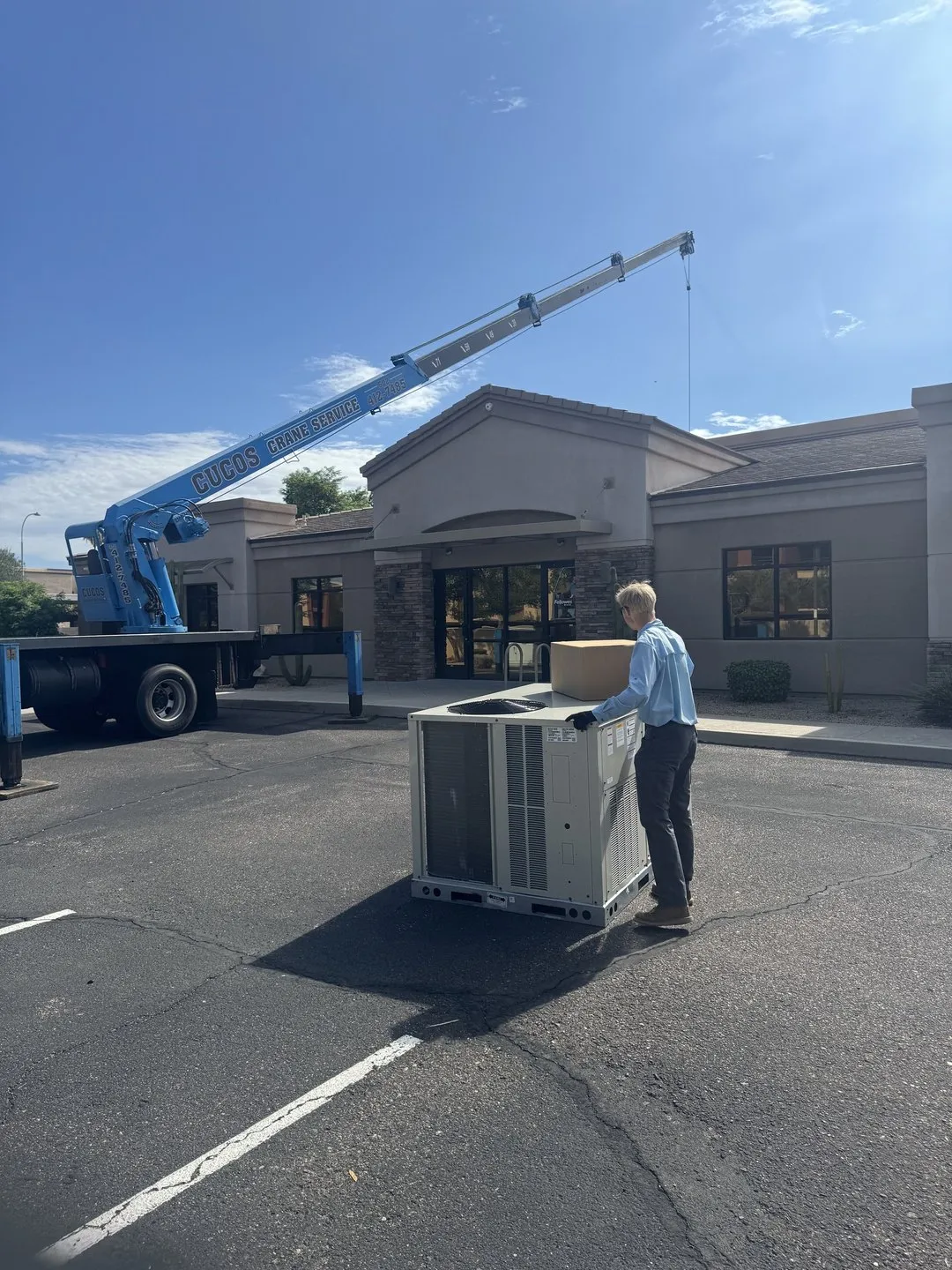
A new air conditioner is a significant purchase, and the need for one usually surfaces in July, when the system fails under peak load. Helping Hands installs new AC systems across Glendale, Peoria, Surprise, Scottsdale and Phoenix, and every replacement begins with the same evaluation: whether replacement is warranted, or whether a repair is the better value.
When repair is the better value, that is what we recommend. When replacement is warranted, you receive options in writing, a system sized to the house rather than to the old nameplate, and an installation commissioned to the manufacturer’s specifications. Owner-operated, based in Glendale, ROC #365835, bonded and insured. The written price you approve is the price you pay on install day.
When replacement actually makes sense
Full-unit replacement is recommended far too often once a system passes ten years of age. These are the conditions that make replacement the better value.
- The compressor has failed. On a system past ten years, a compressor is the one repair that is rarely cost-effective. The part is expensive, the labor is significant, and every other component in the system has the same fifteen Valley summers on it.
- It runs on R-22. R-22 refrigerant has not been produced since 2020, and the remaining supply is expensive and shrinking. A minor recharge on an R-22 system may still be worthwhile. A major leak or a compressor replacement on one rarely is.
- It has needed a repair two or three summers in a row. A single repair in one year is normal. A fan motor, then a contactor, then a refrigerant leak is a pattern of declining reliability. Total the repairs to date and add the likely cost of the next one.
- It’s fifteen or more years old and struggling to keep up. Not failed, but running from 11 a.m. to 9 p.m. and falling behind by late afternoon. Efficiency has declined sharply, and the difference appears on the APS or SRP bill.
- The house has changed and the system hasn’t. An addition, a converted garage, new windows, or a finished patio room all change the load. A system that was correct for the original house may now be undersized or, more often, sized for a floor plan that no longer exists.
- You’re planning to be in the house a while. The longer you own the home, the more a new system’s lower operating cost and warranty return to you.
What does not, by itself, mean replacement: a bad contactor, a clogged drain line, a fan motor, a thermostat, or a leaky duct. Those are AC repairs, and we perform them daily on units with substantial service life remaining. If you have been quoted a full system for one of those faults, request a free second opinion before signing.
Sizing: the decision that matters more than the brand
Phoenix fact. A large share of Valley homes built in the 1990s and 2000s were fitted with air conditioners a half-ton to a full ton bigger than the house actually needed. Larger is not safer. An oversized unit cools the air quickly, shuts off before it has pulled the humidity out, and cycles on and off dozens of extra times a day, which is exactly what wears out a compressor.
The single most common mistake in AC replacement is matching the tonnage on the old unit. That figure was chosen by a builder’s contractor twenty years ago, often by rule of thumb, and often before the trees matured, the windows were replaced, or the attic was reinsulated. Copying it forward copies the error forward.
A load calculation is available upon request. It measures the house rather than estimating from square footage alone: ceiling heights, window sizes and which direction they face, insulation levels, how much of the roof takes direct west sun, how many people live there, and what shape the ductwork is in. The result tells us what size system the house needs today. Sometimes it matches the outgoing unit. Often it is smaller, and the difference is evident on the first monsoon-season afternoon when the house holds temperature without the cold, damp feel of an oversized system.
Right-sizing also affects what equipment makes sense. A variable-speed or two-stage system can run at a lower capacity most of the day and step up when the heat demands it, which is a good fit for a house that was previously oversized. We explain where that investment is justified and where a correctly sized single-stage system is the better purchase.
Ductwork: inspected before equipment is specified
A new air conditioner connected to deficient ductwork will not deliver its rated performance. Before we recommend equipment, we inspect the ducts.
In Valley attics we routinely find crushed or kinked flex duct, runs that have pulled apart at the joints, return air that’s undersized for the system, and supply plenums leaking a meaningful share of your cooled air into a 140-degree attic. None of that is corrected by new equipment. Some of it is made worse, because a new blower with higher static capability pushes harder against the same restrictions.
One of our Google reviewers, Abraham, described the process after his installation: we inspected the home first to confirm there were no issues with the ventilation and duct system, and the evaluation showed his old unit was undersized for the house. That is the order of operations on every job. Ducts first, then sizing, then equipment. If the ductwork requires work, it appears in the estimate as its own line item with its cost and purpose stated. For the full picture on airflow, filtration and duct sealing, see indoor air quality.
What the 2025 refrigerant change means for you
Starting in 2025, manufacturers stopped building new residential systems around R-410A and moved to refrigerants with a lower global-warming rating, most commonly R-454B and R-32. This is what the change means for a buyer today.
- New equipment is a little different, not experimental. The new refrigerants are mildly flammable under specific conditions, so the equipment carries updated sensors and installation standards. These refrigerants have been in wide use overseas for years. Installed correctly by a licensed contractor, they require no special consideration from the homeowner.
- Existing R-410A systems are not obsolete. Parts and refrigerant for R-410A will remain available for many years. A sound R-410A system should stay in service.
- R-22 is the refrigerant to move away from. If your system runs R-22, every refrigerant repair carries a premium, and a major leak usually makes replacement the correct recommendation.
- The change is not a reason to accelerate or delay. Replace when the system has reached the end of its service life, not in response to the refrigerant transition.
Your estimate states which refrigerant each option uses and what that means for future service.
Heat pump versus AC with a gas furnace
Most Valley homes are best served by a heat pump: one outdoor unit and one indoor air handler that cools in summer and reverses to heat in winter. Valley winters are mild enough that a modern heat pump heats efficiently through January with limited use of the electric backup strips, and there is one system to maintain rather than two.
A straight air conditioner paired with a gas furnace remains appropriate in some homes: existing gas service and a furnace with years of life left, a preference for gas heat, or a furnace-based configuration that would be costly to change. We price both when both are reasonable options and explain the tradeoffs. For furnace and heat pump heating specifically, see heater replacement.
Rooftop package units and split systems
The Valley has two dominant configurations, and the one in your home depends mostly on when it was built.
Rooftop package units hold the compressor, coil and blower in one cabinet on the roof, with the ducts running down into the house. They are standard on block homes from the 1960s through the 1980s across Glendale, central Phoenix and the Sun Cities, and on most light commercial buildings. Replacement involves a crane lift, a curb adapter if the new footprint differs, and attention to the roof penetration and condensate drain. We coordinate every part of it.
Split systems put the condenser on a pad beside the house and the air handler in the attic, a hall closet or the garage. That is the configuration in most homes built from the 1990s onward, including Arrowhead Ranch, Vistancia, Marley Park and north Scottsdale. Attic air handlers bring their own considerations: condensate drainage and float switches, access for future service, and how much heat the air handler and ducts absorb up there.
Ductless mini-splits serve additions, casitas, converted garages and rooms the central system has never conditioned adequately. We install Mitsubishi and Daikin ductless systems as standalone solutions or alongside a central system.
Efficiency, SEER2 and where the investment pays back
Every new system carries a SEER2 rating, the current federal efficiency standard. Higher is more efficient. The question is how much additional efficiency justifies its cost in Phoenix specifically.
On APS or SRP time-of-use plans, the electricity you use between 4 and 7 p.m. costs the most, and that is when a Valley air conditioner works hardest. A more efficient system, or a variable-speed system that can run at low capacity through that window, cuts the most expensive hours on your bill first. That is where efficiency pays back here in a way it does not in milder climates.
That said, the jump from a base system to a mid-tier system usually pays back much faster than the jump from mid-tier to top-of-the-line. We present two or three options in writing with realistic operating cost differences and our recommendation. Ask about current APS and SRP rebates during the estimate visit; programs change, and some equipment qualifies while other equipment does not.
Brands we install
We install Trane, Goodman, Daikin, York, American Standard and Mitsubishi, and we service every make. In our experience the brand matters less than the sizing and the installation. A correctly sized, correctly charged, properly commissioned Goodman will outlast and outperform a premium system that was oversized and installed without commissioning. We recommend the brand and tier that fit the house and the budget.
How a replacement works
- Call or text (602) 456-1464 for a free estimate. Describe what the system is doing and its age. If the symptoms indicate a repair, we tell you before scheduling the visit.
- We come out, inspect, and measure. Ductwork, attic or roof access, electrical and the existing equipment. A load calculation for the house as it is today is available upon request. Have your questions and any other quotes ready.
- You get options in writing. Usually two or three, with sizing, efficiency, refrigerant, warranty terms and the full installed price on each. Duct repairs, if needed, are a separate line item. The written price is the price you pay. There is no deadline on the estimate.
- Install day. Most residential replacements are done in a day. We protect floors, recover the old refrigerant properly, set the new equipment, replace the line set or flush it as the manufacturer requires, wire and set the new thermostat, and clean up completely.
- Startup and commissioning. This is the step most often omitted by rushed crews and the one that most determines how long the system lasts. We verify refrigerant charge, airflow, static pressure, temperature split and electrical draw against the manufacturer’s specifications.
- Walkthrough and warranty registration. We review the system, the filter, the thermostat and the drain with you, answer your questions, then register the equipment with the manufacturer in your name so the full parts warranty is on record.
After installation, a maintenance schedule is what extends a fifteen-year system toward twenty.
What AC replacement involves in each city
We are based in Glendale and install across the West Valley and Phoenix. Notes on what we see in each city.
Glendale: original rooftop units and 1990s split systems
The block homes around downtown Glendale and along 59th and 67th Avenues are largely on rooftop package units, many of them original equipment or first replacements well beyond their expected service life. Out in Arrowhead Ranch and along the Loop 101, the split systems installed during the 1990s build-out are hitting the end of their second life, and attic ductwork from that era is often part of the conversation. Glendale is our home base, and estimates here are the quickest to schedule.
Peoria: mid-2000s builder systems and oversizing
Peoria’s newer neighborhoods, including Vistancia and the homes north of Happy Valley Road, are reaching the age where builder-grade systems installed in the mid-2000s need replacing, and oversizing from that era is common. Older Peoria along Grand Avenue and around Old Town leans rooftop. See AC replacement in Peoria.
Surprise: whole neighborhoods reaching end of life together
Surprise added tens of thousands of homes in a few short years around Bell Road, Marley Park and the neighborhoods west of Grand, and many of those systems are reaching end of life on roughly the same schedule. Sun City Grand and the surrounding age-restricted communities are almost entirely rooftop units, and we handle crane lifts and HOA coordination there regularly. See AC replacement in Surprise.
Scottsdale: duct inspections and multi-system sizing
South Scottsdale’s 1960s and 1970s block homes are rooftop territory, often with ductwork modified through several remodels that requires inspection before new equipment is specified. North Scottsdale homes commonly run two or three systems, and replacing one is the appropriate time to review the sizing and zoning of the others. See AC replacement in Scottsdale.
Phoenix: rooftop homes, split systems and historic districts
North Phoenix and the neighborhoods along the I-17 corridor are a mix of 1970s and 1980s rooftop homes and 1990s split systems. Historic central Phoenix districts add older ductwork and tight attic access to the equation. We also replace rooftop units on small commercial buildings across West Phoenix. See AC replacement in Phoenix.
We also install regularly in Goodyear, Avondale, Litchfield Park, Sun City, Sun City West, Anthem, Cave Creek and Paradise Valley. If your area is not listed, call to confirm coverage.
Why homeowners trust us with a new AC system
- Replacement only when it is the better value. Full replacement is recommended far too often. If a repair provides several more summers of service, that is our recommendation.
- The estimate is free and in writing. Options, sizing, warranty terms and the full installed price. The estimate does not expire.
- Sized to your house. Never copied from the old nameplate. Load calculation available upon request.
- Ducts inspected first. New equipment on deficient ductwork underperforms, so we inspect before we quote.
- Owner-operated. Aaron Hoberg holds the license and oversees every job. Based in Glendale.
- Licensed, bonded and insured. Arizona ROC #365835, CR-39 Air Conditioning and Refrigeration, residential and commercial.
- Commissioned and registered. Every install is commissioned to manufacturer spec and registered for warranty in your name.
- 5.0 stars on Google. Several of our reviews are from replacement customers.
- Financing options available. Ask during the estimate visit.
Questions about replacing your AC
Answers to the questions we are asked most often. For anything else, call or text (602) 456-1464.
How do I know if I need a new AC or just a repair?
Look at three things: the age of the system, what failed, and how many times it has failed recently. A ten-year-old unit with a failed contactor is a repair. A fifteen-year-old R-22 system with a failing compressor that was repaired last summer is usually a replacement. We present both figures in writing with our recommendation. If another contractor has recommended replacement, our second opinion is free.
How long does a Valley air conditioner last?
Ten to fifteen years is a normal life in the Phoenix area, and well-maintained systems sometimes go longer. That is shorter than the national average because our equipment runs close to double the hours of a unit in a milder climate, most of it in an attic or on a roof that passes 140 degrees. Twice-a-year maintenance is the single biggest factor in landing at the long end of that range.
What size air conditioner does my house need?
Not necessarily the same size as the one coming out. A load calculation, available upon request, accounts for your square footage, ceiling height, insulation, window orientation, sun exposure and ductwork. Many Valley builder homes were fitted with oversized units that cool the air fast, shut off before they pull the humidity out, and short-cycle their compressors to an early death. Right-sizing is the most important decision in the whole project.
What is the new refrigerant and does it change what I should buy?
As of 2025, new residential systems ship with lower-global-warming refrigerants, most commonly R-454B or R-32, instead of R-410A. For you as a buyer it means new equipment is slightly different from what your neighbor installed three years ago, parts and refrigerant for R-410A systems will stay available for years, and there is no reason to accelerate or delay a replacement because of it. If your current system still runs on R-22, that refrigerant has not been produced since 2020 and a major leak usually tips the math toward replacement.
Should I get a heat pump or an air conditioner with a furnace?
In the Valley, a heat pump is the right answer for most homes. Our winters are mild enough that a heat pump heats efficiently all season without the backup strips running much, and you get one piece of equipment instead of two. A straight AC paired with a gas furnace still makes sense if you already have gas service, a furnace with life left in it, or a strong preference for gas heat. We price both options when both are reasonable for the home.
Do you install rooftop units?
Yes. Rooftop package units are standard on thousands of Glendale, Phoenix, Sun City and Scottsdale homes, especially block homes from the 1960s through the 1980s and most age-restricted communities. We replace them with a crane, coordinate the lift, and handle the curb adapter if the new unit has a different footprint. We also install split systems with an attic or closet air handler and ductless mini-splits for additions and casitas.
Do you offer financing on a new system?
Yes, financing options are available. Ask during the estimate visit and we will present the available terms and the monthly figures alongside the cash price. Financing is optional, and the estimate is free with no obligation to purchase.
Is the manufacturer warranty registered in my name?
Yes. We register your equipment with the manufacturer after startup so the full parts warranty is on record in your name, not ours.