
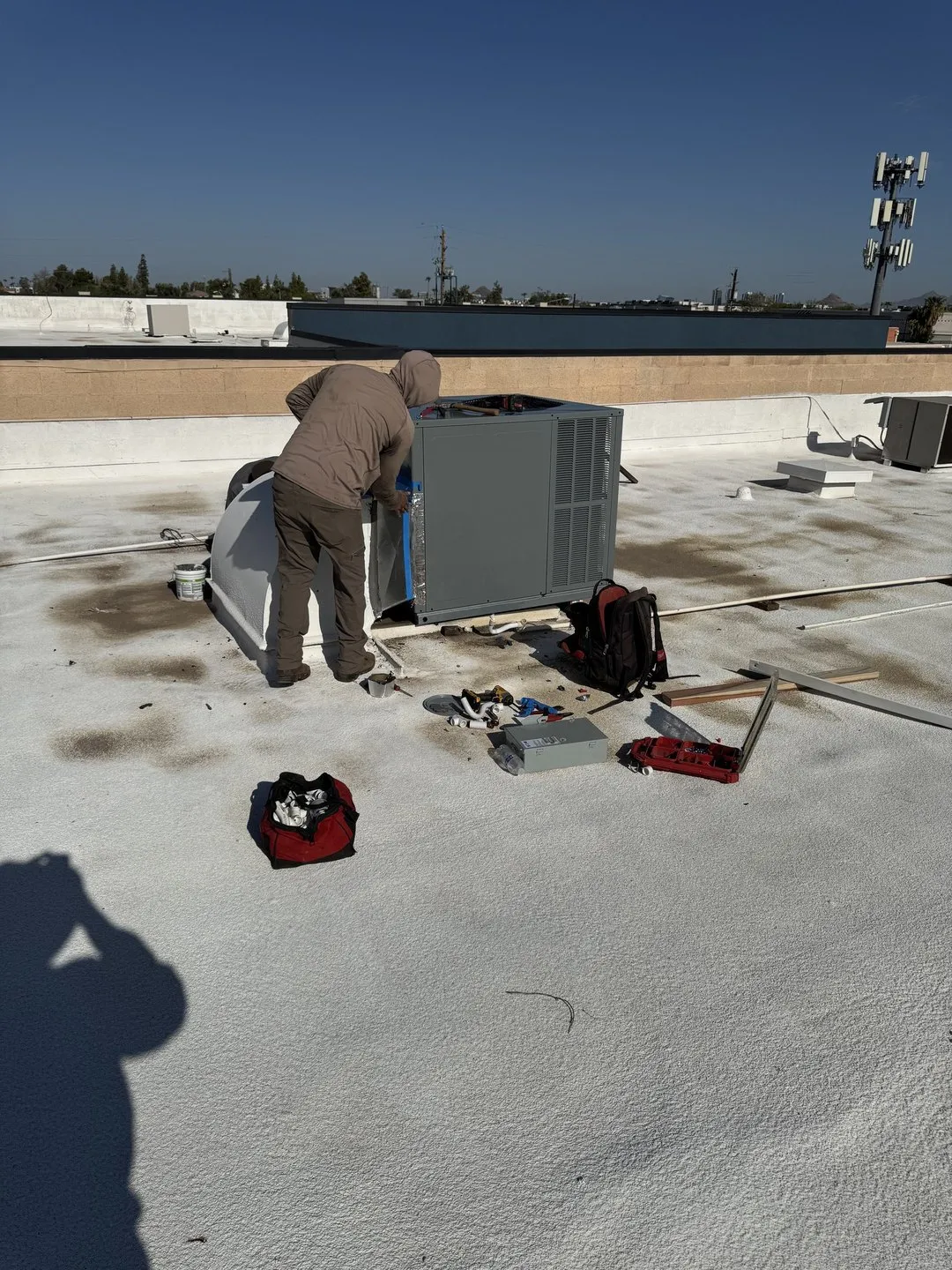
Phoenix is a large city, so we are specific about coverage. Helping Hands is based in Glendale, and the Phoenix neighborhoods we serve every week are the ones within a short drive of it: West Phoenix and Maryvale, Sunnyslope and Moon Valley, the historic districts around downtown, and the I-17 corridor north through Deer Valley, Norterra and Anthem. If you live in North, West or Central Phoenix, you are inside our core service area.
That covers a great many homes, and they do not fail the same way. A 1955 block house in Maryvale with a rooftop unit and a 2006 two-story in Norterra with an attic air handler have little in common beyond the fact that both will fail on the hottest day of the year. Call or text (602) 456-1464, provide the neighborhood and describe what the system is doing, and you will receive a scheduled arrival window and a complete diagnosis.
HVAC services for North, West and Central Phoenix
Every service on this site is available anywhere in our Phoenix core.
- AC repair. Same-day on most calls. Contactors, fan motors, refrigerant leaks, frozen coils, drain clogs and control boards, on rooftop package units and split systems alike.
- AC replacement and installation. Sized to your house rather than to the figure on the old nameplate, with a load calculation available upon request, and installed to code. Trane, Goodman, Daikin, York, American Standard and Mitsubishi.
- Heating repair. Heat pumps stuck in cooling mode, auxiliary strips running up the winter bill, and the older gas furnaces still operating in Sunnyslope and the central districts.
- Heater replacement. Heat pumps and furnaces sized to a Phoenix winter that lasts about six weeks, so you are not paying for capacity you will not use.
- Indoor air quality. Improved filtration, UV lights, duct sealing and return-air corrections for monsoon dust and winter particulate pollution.
- Maintenance and tune-ups. Spring and fall visits that catch a worn component before it fails in August.
- Free second opinions. An independent evaluation of any replacement recommendation before you commit to the expense.
- Free estimates. Detailed, written and free for replacements, installations and air quality work.
Common HVAC problems in Phoenix, by area
Phoenix grew in rings, and each ring was built with a different approach to cooling a house. Here is what we see most, by area.
Rooftop units and original ductwork in Maryvale and West Phoenix
The John F. Long tract neighborhoods west of the I-17, roughly from Camelback Road south through Maryvale and west toward the Loop 101, are block homes from the 1950s and 1960s. Many began with evaporative coolers and were converted to refrigerated air years later, which means the ductwork was never designed for the airflow a modern system requires. Nearly all of them cool with a package unit on the roof.
Phoenix fact. A rooftop package unit in Maryvale sits in the hottest air on the property from May through October. Cabinet surfaces routinely pass 150 degrees on a July afternoon, so the fan motors and electrical parts inside wear out sooner than they would in a shaded side yard.
Most of those failures are routine repairs and the parts are stocked. What we evaluate carefully is the airflow side: crushed or disconnected flex duct in a low attic, a return sized for an evaporative cooler, a unit that cannot keep up because half its air never reaches the bedrooms. Homeowners in Maryvale are often making careful budget decisions, and the correct recommendation is frequently a repair plus a duct correction rather than a new system.
Hillside homes and older furnaces in Sunnyslope, Moon Valley and North Central
North of Northern Avenue and against the mountain preserves, Sunnyslope, Moon Valley and the North Mountain neighborhoods hold homes from the 1940s through the 1970s on lots that were never flat. Equipment is mixed: rooftop units on the older ranches, side-yard condensers on the remodels, and more gas furnaces on Southwest Gas than almost anywhere else in our service area.
Those furnaces are the winter story here. Ignitors, flame sensors and limit switches on twenty-year-old units, and the occasional heat exchanger that requires a proper inspection. In summer the hillside lots add their own complication: condensers set against a slope or a block wall that cannot reject heat, and long refrigerant lines from a remodel that make a small leak difficult to locate. We bring the instruments to find it rather than recharging the system and leaving.
Retrofits and mini-splits in Alhambra and the historic districts
Willo, Coronado, F.Q. Story and the other historic districts between McDowell and Camelback, plus the older streets of Alhambra, are homes from the 1920s to the 1950s built long before central air. Everything cooling them today was retrofitted, often two or three times, and the returns are typically small and poorly placed.
Uneven cooling is the call we receive most from these neighborhoods. In some cases the correction is a return-air or duct modification. For a converted porch or a rear addition, the appropriate solution is often a ductless mini-split, which we install and service. In every case we begin by measuring how air moves through the house rather than quoting a larger unit the ductwork cannot deliver.
Second- and third-generation systems along the I-17 corridor
Deer Valley, Norterra and the tracts along the I-17 from Thunderbird Road to Happy Valley Road were built from the 1980s through the 2000s, and the builder heat pumps in the 2000s and 2010s subdivisions are now reaching the age where compressors and coils begin to fail. These are split systems with the air handler in the attic, and many are on their second or third unit.
The pattern is familiar. Attic temperatures near 140 degrees are hard on blower motors. Condensate drains clog until the float switch trips, or until it fails to and a stain appears on the ceiling. The original builder’s contractor typically sized the system by rule of thumb, so a replacement that copies the old tonnage keeps the house short-cycling through monsoon season. When one of these reaches the end of its service life, we review the repair-or-replace figures with you and size any new system to the house rather than the old tonnage. A load calculation is available upon request.
Colder nights and HOA requirements in Anthem, Desert Ridge and Paradise Valley Village
Anthem, the Del Webb community at the top of the I-17, was built between 1999 and 2007 and sits high enough that winter nights run colder than the rest of the Valley. That appears as heat pumps relying on auxiliary electric strips for more hours than a central Phoenix home would, and as APS bills that rise sharply in January. Correct defrost cycle operation and strip staging matter more here.
Desert Ridge and Paradise Valley Village on the north side are newer and larger homes, often running two systems, and both areas have HOAs that regulate equipment placement and visibility from the street. We inspect both systems on every visit, not only the one that failed, and we identify any placement rule that requires approval before installation day.
Commercial rooftop units along Bell Road and the I-17
Along Bell Road, Cave Creek Road, 19th Avenue, Camelback Road and the I-17 frontage, most small commercial buildings run several rooftop package units, and a restaurant kitchen or a busy shop places heavy demand on them. We service, maintain and replace light commercial rooftop equipment across our Phoenix core with the same written pricing we provide homeowners.
One condition affects every Phoenix neighborhood: the air. From late June through September, monsoon storms push walls of dust across the city, and the outdoor coil on every condenser and rooftop unit accumulates a layer of fine grit that prevents it from rejecting heat. Head pressure climbs, amp draw climbs, and a system that performed normally in May struggles in August. A rinse after each major storm and a proper coil cleaning every spring is the least expensive efficiency improvement available to most Phoenix homeowners.
Winter brings the opposite problem. On still, cold mornings a layer of particulate pollution settles over the central city and the I-17 corridor, and it enters through every leaky duct and undersized return. A better filter, a sealed duct system and, where appropriate, a whole-home purifier or UV light at the coil keep the indoor air cleaner than the outdoor air. We cover the options on our indoor air quality page and recommend the ones that apply to your house.
Why Phoenix homeowners call Helping Hands
- Owner-operated and nearby. Based in Glendale, twenty minutes from most of North and West Phoenix. Aaron Hoberg, the owner, oversees every job.
- Same-day service on most calls. With a scheduled arrival window and a text when the technician is on the way.
- A written price before work begins. A flat, final number approved by you. No added line items.
- Repair when it is the better value. Full replacement is recommended too readily once a unit passes ten years. If your system has serviceable life remaining, we say so and explain why.
- Licensed, bonded and insured. Arizona ROC #365835, CR-39 Air Conditioning and Refrigeration, dual residential and commercial.
- 5.0 stars on Google. Honesty is the quality customers mention most.
- HOAs handled. Familiarity with the Anthem, Desert Ridge and Norterra HOA requirements.
- All brands, both utilities. Trane, Carrier, Lennox, Goodman, Daikin, York, American Standard, Rheem and the rest. APS and SRP customers alike.
From your call to a written price in Phoenix
- Call or text (602) 456-1464. Provide the neighborhood and describe what the system is doing. If the cause is something you can safely check yourself, such as a tripped breaker or a loaded filter, we will tell you before dispatching.
- You receive a scheduled arrival window. We text when the technician is on the way.
- A full diagnostic. Refrigerant pressures, amp draw on the motors, airflow, the drain line, the thermostat. On a rooftop unit, the inspection is performed on the roof.
- The price in writing before any work begins. Flat and final. You approve it, then the work starts.
- Repaired the same day on most calls. The parts that fail most often in this climate are stocked on the truck. We review the failed component with you, clean up, and confirm the system is holding temperature before leaving.
If replacement is the better value, you receive a free written estimate with options, and you decide on your own schedule. If another company has already recommended replacement, our second opinion is free.
What Phoenix homeowners ask before booking
Answers to the questions Phoenix homeowners ask most often. For anything else, call or text (602) 456-1464.
Which parts of Phoenix do you actually cover?
North Phoenix, West Phoenix and Central Phoenix are our core: Maryvale and everything west of the I-17, Sunnyslope and Moon Valley, the historic districts around downtown, the I-17 corridor through Deer Valley and Norterra, and Anthem and Desert Ridge on the north side. All of that sits within about 30 minutes of our Glendale base. Ahwatukee and the far East Valley are by arrangement; call and we will confirm availability.
How fast can you get to a Phoenix home when the AC is out?
Most Phoenix calls in our core area receive same-day service. When you book you receive a scheduled arrival window rather than an all-day range, and we text when the technician is on the way. During a July heat wave we quote a realistic window based on the day's schedule rather than commit to a time we cannot keep.
My Maryvale house has the AC on the roof. Is that worth repairing or is it time for a new one?
Usually worth repairing. The rooftop package units on the block homes in Maryvale and West Phoenix fail in predictable ways: contactors, fan motors, a clogged condensate drain. Those are routine repairs and the parts are stocked. Age alone is not a reason to replace. If the compressor has failed or the cabinet has rusted through, we show you what we found and provide repair and replacement figures side by side.
Am I on APS or SRP, and does it change anything?
Phoenix is split. SRP serves more of central and east Phoenix, APS serves more of the north and west side, and the boundary runs through some neighborhoods, so check the name on your bill. It matters for time-of-use pricing, where a failing system running long between 4 and 7 p.m. adds real cost, and for rebates on high-efficiency equipment, which both utilities change from year to year. Ask us what is current when you are weighing a replacement.
Can you work on the older homes in Willo, Coronado and the other historic districts?
Yes. Homes from the 1920s through the 1950s were not built for ductwork, so what exists was retrofitted, often more than once, and returns are usually undersized. We measure how air actually moves through the house before making a recommendation, and where an addition or converted porch never received adequate cooling, a ductless mini-split is often the appropriate solution.
Is Anthem inside your service area? It's a long way up the I-17.
It is. Anthem and the Del Webb neighborhoods around it are in our regular rotation. Homes there are one to two decades into their service life, sit higher than the rest of the Valley, and see colder winter nights, so heat pump heating performance and auxiliary strip usage come up more often than in central Phoenix. We also know the HOA's requirements on equipment placement.
Do you handle commercial HVAC in Phoenix?
Light commercial, yes. Rooftop package units on shops, restaurants and offices along Bell Road, Cave Creek Road, 19th Avenue, Camelback Road and the I-17 corridor. Repairs, maintenance and replacement with the same written pricing homeowners receive.
Phoenix neighborhoods and ZIP codes on our routes
All of Phoenix, including Maryvale, Sunnyslope, Moon Valley & North Mountain, North Central, Alhambra, Willo, Coronado & F.Q. Story, Deer Valley, Norterra, Anthem, Desert Ridge and Paradise Valley Village, and every Phoenix ZIP code: 85013, 85014, 85015, 85017, 85019, 85020, 85021, 85022, 85023, 85027, 85029, 85031, 85033, 85035, 85037, 85051, 85053, 85083, 85085 and 85086. If your neighborhood is not listed, call to confirm coverage.