
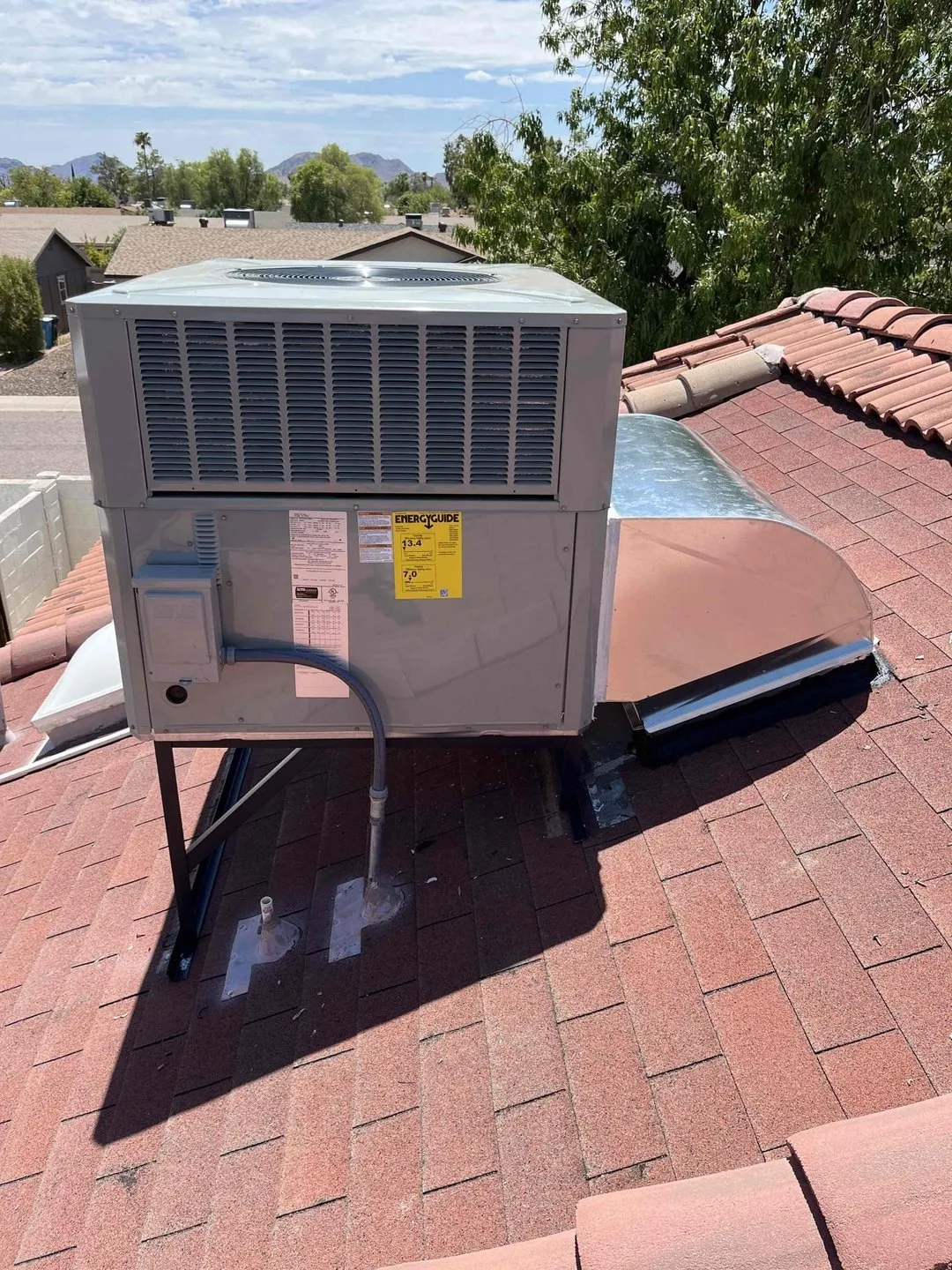
Most Phoenix homes do not have a heater the way a house in Denver does. They have a heat pump, or a rooftop package unit, that cools for eight months and quietly heats for a few weeks in winter. So when the heat fails, the question is rarely which furnace to buy. It is how much service life remains in the system that also cools the house, and what should replace it. Helping Hands replaces heat pumps, gas furnaces and rooftop package units across Glendale, Peoria, Surprise, Scottsdale and Phoenix, and every job begins with that evaluation.
We are an owner-operated company based in Glendale. Call or text (602) 456-1464 to schedule a free estimate. You receive two or three options with the installed price written next to each and our recommendation for a home that heats for a few hundred hours a year and cools for a few thousand. A load calculation on your house is available upon request.
When it makes sense to replace instead of repair
Replacement is recommended far too often in the Valley. Before agreeing to a new system, these are the conditions that point toward replacement rather than repairing your heater:
- The cooling side is failing too. If the compressor is weak, the coil is leaking, or the system has required a refrigerant recharge every summer, the heating failure is one symptom of a system at the end of its service life. Replacing the whole heat pump or package unit fixes both.
- The system still runs on R-22. That refrigerant is no longer produced. A leak on an R-22 heat pump changes the repair calculation, because the repair is expensive and temporary.
- Electric strip heat is your only heat. A blower and a set of resistance strips is the least expensive heating a builder can install and the most expensive to operate. Replacing it with a heat pump cuts winter APS or SRP bills sharply.
- Twelve to fifteen years old and on its second or third major repair. A fan motor, then a blower motor, now a reversing valve or a control board. At that point you are paying for a new system one component at a time.
- Cracked heat exchanger on a gas furnace. This is the one heating failure where replacement is not optional. A cracked exchanger can release combustion gases into the house and the furnace must be removed from service.
- Rooms that never got comfortable. A system that was oversized or undersized from installation cannot be corrected with a component. Replacement is the opportunity to size it correctly.
- The house is being remodeled or the ducts are shot. If the ductwork is being replaced, replacing the equipment at the same time is the efficient approach.
If none of those conditions apply and the fault is a single failed component, we repair it. If another contractor has recommended replacement, our second opinion is free.
Three ways to heat a Valley home
Phoenix fact. A typical Phoenix home runs its heat for a few hundred hours a year and its cooling for well over two thousand. Whatever you install to heat the house will spend most of its life cooling it, so the cooling side should drive the decision.
Heat pump. The default for most Valley homes and the appropriate choice for most homeowners. A heat pump is an air conditioner that can run in reverse: in summer it pumps heat out of the house, in winter it pumps heat in from outside air. At Phoenix winter temperatures, 35 to 55 degrees on the cold nights, a heat pump is extremely efficient because there is still plenty of heat in the outdoor air to move. It comes as a split system with an air handler in the attic or a closet, or as a rooftop package unit with everything in one cabinet. One system, one set of ducts, one piece of equipment to maintain.
Gas furnace paired with an air conditioner. Common in older Glendale and Phoenix neighborhoods that have Southwest Gas service, and in some higher-end Scottsdale homes. The furnace heats, a separate outdoor condenser cools, and they share the indoor blower and ducts. Gas heat recovers quickly and the supply air is hotter, which some homeowners prefer. The trade-off is two pieces of equipment to purchase and maintain, and a high-efficiency furnace rarely pays back its premium here. A 96-percent furnace saves a meaningful amount over an 80-percent unit when it runs 1,500 hours a winter in Ohio. When it runs 300 hours in Peoria, the savings are small and the additional cost of the condensing furnace, plus the drain and venting it requires, is rarely recovered. We usually recommend a standard 80-percent furnace and applying the difference to a higher-grade air conditioner.
Dual-fuel. A heat pump for cooling and mild heating, with a gas furnace that takes over on the coldest nights. It is the most efficient heating configuration on paper and the most expensive to install. In this climate the furnace would operate a handful of nights a year, so dual-fuel is appropriate mainly for larger homes with existing gas service.
Whichever configuration fits your house, we present the figures side by side.
Heating equipment we replace
- Heat pumps, split and package. The standard equipment of the Valley. Trane, Goodman, Daikin, York, American Standard and Mitsubishi systems sized to your house rather than to the outgoing unit.
- Rooftop package units. Everything in one cabinet on the roof, standard on older Glendale, Phoenix and Sun City homes and on the small commercial buildings we serve. Replaced in one day with a crane lift.
- Gas furnaces. Standard-efficiency and high-efficiency units for homes on Southwest Gas, paired with a new or existing condenser. Includes the flue, gas connection and combustion safety testing.
- Air handlers with electric strip heat. Replaced with heat pump air handlers, or upgraded to a matched heat pump system so the strips become backup instead of the only heat.
- Ductless mini-split heat pumps. For casitas, garage conversions, additions and rooms the central system does not condition adequately. Mitsubishi and Daikin single-zone and multi-zone.
- Thermostats and controls. A new system requires a thermostat capable of controlling it, particularly a variable-speed heat pump. We install and configure smart thermostats and review their operation with you.
- Ductwork that needs it. Crushed flex duct, disconnected runs and leaking returns in the attic will make a new system underperform. We inspect the ducts as part of the estimate and repair or replace what is required. See indoor air quality for the air side of that work.
How a heater replacement works
- Call or text (602) 456-1464 for a free estimate. Describe the symptoms and the age of the system. If the symptoms indicate a repair, we tell you before scheduling the visit.
- An on-site assessment, in the attic and on the roof. We measure the house, inspect the ducts, and check the electrical and gas service. A replacement quote prepared without that inspection is an estimate in name only. A load calculation is available upon request.
- Options in writing. Two or three systems that fit the load, with the full installed price next to each and a clear explanation of what the difference in price provides. The written price is complete.
- You select, we schedule. Most replacements are completed in a single day. Rooftop units get a crane.
- Installation, startup and walkthrough. Old equipment removed and disposed of, new equipment set and connected, refrigerant charge and airflow verified, thermostat configured, and a walkthrough with you before we leave. We register the warranty in your name.
Sizing for a cooling-dominated climate
Most of the country sizes heating equipment for the coldest night of the year. That approach in Phoenix produces a heat pump that is too large for the cooling season, and an oversized system performs poorly in July. It cools the air fast, shuts off before it has removed the humidity monsoon season brings in, and starts again ten minutes later. That short cycling wears out compressors and leaves the house humid.
We size for the July afternoon. We start from the cooling capacity your house actually needs (a load calculation is available upon request), pick the heat pump that matches it, and then confirm the heating side covers a January morning with margin. In the Valley it almost always does, with margin. If a room in your house has never held temperature, that is addressed at this stage, through the ducts serving it rather than a larger unit.
For homes that currently rely on electric strip heat, the sizing conversation is also a bill conversation. Strips produce heat by resistance: one unit of electricity in, one unit of heat out. A heat pump moves heat and returns two to three units for every one in at Valley winter temperatures. Replacing strips with a correctly sized heat pump is one of the few HVAC changes that appears clearly on the next winter bill.
Heater replacement by city and housing type
We are based in Glendale and most of our replacement work is within a 30-minute drive.
Glendale: aging furnaces and second-generation heat pumps
Glendale has both kinds of housing at once. The older blocks around downtown and along Grand Avenue often have gas service and aging furnace-and-condenser pairs, while the 1990s neighborhoods out toward Arrowhead run heat pumps that are now on their second system. We replace both, and we perform many rooftop package unit replacements on the mid-century homes. Heater replacement in Glendale is our home base.
Peoria: attic heat pumps reaching end of life
Newer Peoria, from the 101 north through Vistancia, is almost entirely heat pump country with air handlers in the attic. Those attics are severe on equipment, and many of the original builder systems are reaching end of life at the same time. In older Peoria near Old Town we see more gas furnaces and more rooftop units. Either way, heater replacement in Peoria is a short drive up the 101.
Surprise: single-day rooftop replacements
Surprise built out fast in the 2000s, so whole neighborhoods around Marley Park and Bell Road hit replacement age together. The age-restricted communities, Sun City Grand and the neighborhoods around it, lean heavily on rooftop package units, and homeowners there generally want the work completed in a single day. We schedule crane lifts accordingly. See heater replacement in Surprise.
Scottsdale: duct corrections and dual-fuel systems
South Scottsdale and the older parts near Old Town have block homes from the 1960s and 70s where the heating has been changed a few times and the ducts have not. Replacing the equipment without correcting the ducts compromises the new system, so we evaluate both. North Scottsdale homes often run multiple systems and gas furnaces, and dual-fuel comes up more here than anywhere else we work. Heater replacement in Scottsdale is inside our normal range.
Phoenix: every era, from strip heat to heat pumps
West and North Phoenix cover every era of Valley construction. Maryvale and the neighborhoods off the I-17 have older rooftop units and some of the last electric-strip-only heating we see. Moon Valley and Deer Valley are mostly heat pumps in the twelve-to-fifteen-year window. The historic districts near downtown have gas and tricky ductwork. Heater replacement in Phoenix is a large share of our fall work.
We also replace systems in Goodyear, Avondale, Litchfield Park, Sun City, Sun City West, Anthem, Cave Creek and Paradise Valley. If your area is not listed, call to confirm coverage.
Why homeowners choose Helping Hands for a new heater
- Owner-operated. Aaron Hoberg holds the license and oversees every job. Based in Glendale.
- Replacement only when it is the better value. If your system has service life remaining, we repair it and advise you on the likely replacement timeline.
- Sized to your house and this climate. Never copied from the old nameplate. Load calculation available upon request.
- The price in writing before any equipment is removed. Every option, fully installed, flat and final.
- Licensed, bonded and insured. Arizona ROC #365835, CR-39 Air Conditioning and Refrigeration, dual residential and commercial.
- 5.0 stars on Google. Honesty is the quality customers mention most.
- Financing options and rebate guidance. Ask about current APS and SRP programs for high-efficiency heat pumps.
- Support after installation. Warranty registered in your name, and a maintenance program to protect the system over its service life.
To see what a new system would look like for your house, request a free estimate or call or text (602) 456-1464.
Questions about replacing your heater
Answers to the questions we are asked most often. For anything else, call or text (602) 456-1464.
Do I need a furnace in the Phoenix area, or is a heat pump enough?
For most Valley homes a heat pump is enough, and it is usually the better choice. Phoenix winters are mild, nights in the 30s and 40s for a few weeks, and a heat pump handles that easily while also being your air conditioner for the other eight months. A gas furnace makes sense mainly if your home already has a gas line and a working gas AC-plus-furnace setup, or if you prefer the higher supply air temperature of gas heat on cold January mornings. We present both options in writing.
How long does a heat pump last in Arizona?
Ten to fifteen years is a normal life for a heat pump here, and the cooling side is what wears it out. The unit runs close to double the hours of the same equipment in a milder climate and does most of that work in 110-degree heat. If your heat pump is in that age range and the heating has begun to fail, the question is whether to replace the complete system, and our diagnostic identifies which side is at fault.
My heater is electric strip heat only. Should I switch to a heat pump?
Usually yes. Electric resistance strips turn every unit of electricity into one unit of heat, and on APS or SRP rates that shows up as a big jump on your winter bill. A heat pump moves heat instead of making it and delivers two to three times the warmth for the same electricity in Valley temperatures. If you are replacing the air conditioner anyway, going to a heat pump is often a small added cost that pays you back every winter.
How is a new system sized for a Valley home?
A load calculation, available upon request, looks at your actual house: square footage, ceiling height, insulation, window direction, duct condition and how many people live there. That tells us the cooling load, and in the Valley the cooling load is what sets the size. Oversizing for winter is a common mistake that leaves you with a system that short-cycles all summer. We size for the July afternoon and confirm the heating side covers January with room to spare.
Can you replace a rooftop package unit?
Yes. Rooftop package units are standard on older Glendale, Phoenix and Sun City homes and on most light commercial buildings we serve. Replacement is usually a one-day job with a crane lift: old unit off, new unit set on the existing curb or an adapter, ductwork and electrical reconnected, then startup and testing on the roof.
When is the best time of year to replace a heater in the Valley?
Fall. October through early December is the quiet season for HVAC companies here, so scheduling is easiest, install crews are not racing between no-cooling calls, and you are done before the first cold snap. Spring works too. What we try to help people avoid is replacing in a panic in mid-July or in the middle of a January cold front.
What is included in your heater replacement estimate?
Two or three equipment options with the full installed price written next to each, removal and disposal of the old equipment, the new installation, startup and commissioning, a new thermostat if you want one, and warranty registration with the manufacturer. A load calculation is available upon request. The estimate is free, it is in writing, and the figure on it is the figure you pay.
Do you offer financing or know about utility rebates?
Financing options are available; ask when you call. We also track the current APS and SRP rebate programs for high-efficiency heat pumps and identify what your new system qualifies for and how to claim it.